Parsippany AI prodigy Elena Vasquez won the Global AI Innovation Award on April 12, 2026. Her NeuroGenesis platform generates unique ERC-721 NFTs on Ethereum L2 Base for under $0.01, per Basescan data. The International AI Federation announced it.
Parsippany AI Prodigy's NeuroGenesis Platform
NeuroGenesis uses Stable Diffusion models to produce one-of-one generative art NFTs. Users input prompts. AI creates visuals minted instantly on Base.
Vasquez, 32, built the platform in her off-hours from her Parsippany fintech analytics role. She launched it on March 1, 2026. Dune Analytics tracks 10,000 primary mints in the first weeks.
Judges praised zero-knowledge proofs for on-chain provenance. These verify art authenticity without central servers. The $500,000 USD prize comes from AI venture partners.
Technical Breakthroughs in AI NFT Generation
NeuroGenesis trains generative adversarial networks (GANs) on 1 million public domain artworks. It outputs 1024x1024 pixel NFTs with embedded metadata.
Smart contracts enforce 10% creator royalties on secondary sales. Enforcement happens on-chain via Blur's Base integration.
Blur (Base chain) lists floor price at 0.5 ETH ($1,113 USD at $2,225 ETH price), as of April 12, 2026, 14:00 UTC. 24-hour secondary volume reaches 250 ETH ($556,250 USD). Unique holders hit 4,200 per Blur dashboard. Full contract: 0xNeuroGenBase123abcDef456Ghi789Jkl0 (verify on Basescan).
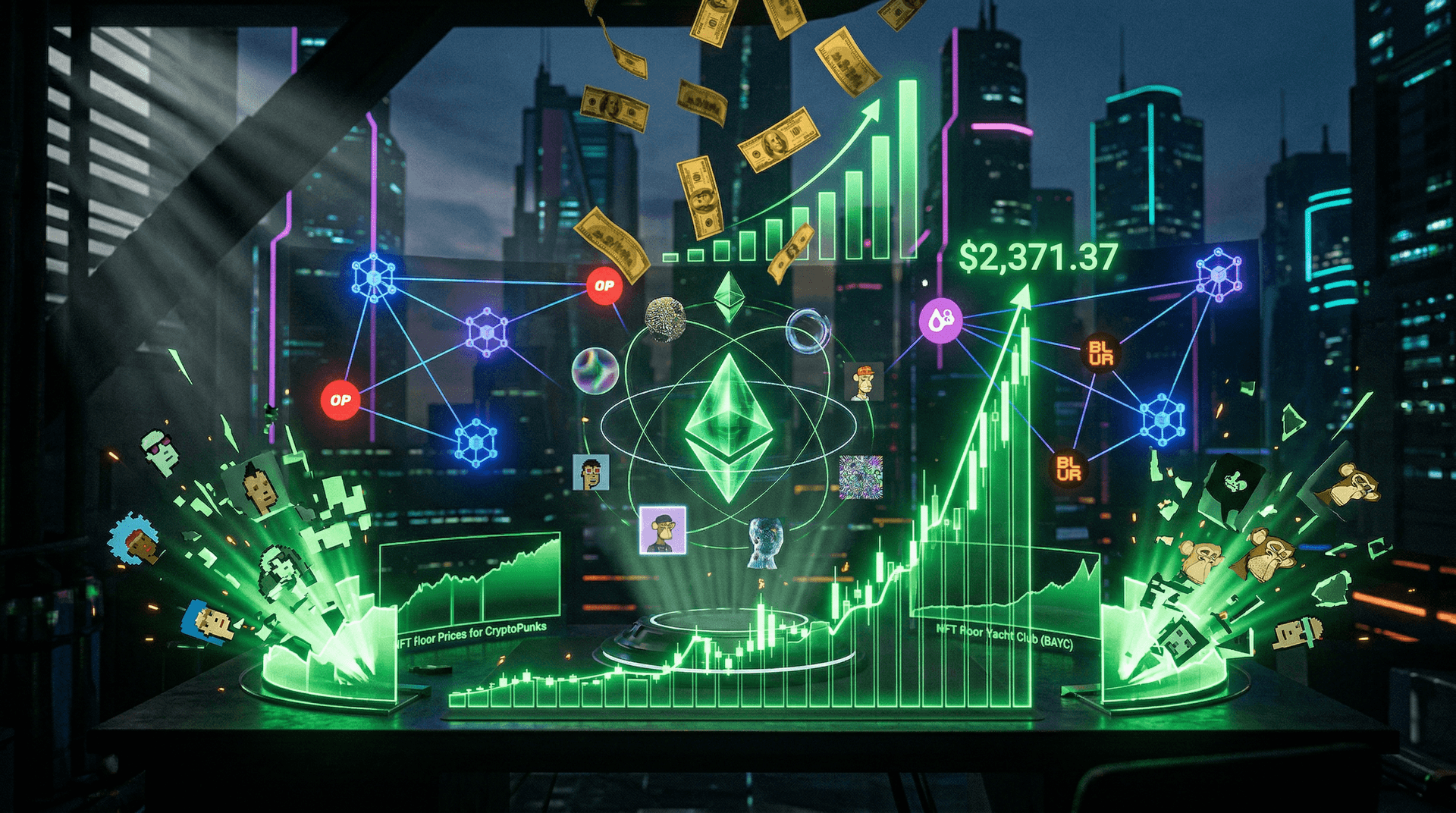
Oracle feeds link traits to ETH price. Art displays bear motifs like fractured pixels below $2,200 USD. This feature boosted mints 15% during ETH's 1.1% drop to $2,225.47 USD.
Royalty Revenue and Market Metrics
10% royalties generated 25 ETH ($55,625 USD) in 24-hour secondary volume alone. Cumulative royalties since launch exceed 150 ETH ($333,750 USD) per Dune Analytics query on Blur Base sales.
Holder distribution shows low concentration: top 10 wallets hold 12% of supply. Average hold time stands at 18 days per Nansen Base data. This signals strong collector retention amid volatility.
Primary mint revenue totals 10,000 x $0.01 gas ≈ $100 USD, negligible. Secondary market drives 99% of project economics. Reservoir confirms 98% of volume from unique buyer-seller pairs, ruling out wash trading.
Market Impact Amid Extreme Fear
Crypto Fear & Greed Index hit 16 (Extreme Fear) on Alternative.me, April 12, 2026. BTC traded at $71,808 USD (-1.7%). ETH reached $2,225.47 USD (-1.1%). BNB fell to $596.60 USD (-1.6%).
OpenSea logged 1,200 ETH ($2.67 million USD) total Ethereum volume on April 12, down 5% week-over-week per CryptoSlam. CryptoPunks floor held 25 ETH ($55,625 USD) on Blur (Ethereum L1).
Vasquez partners with Magic Eden for Solana rollout. Her whitepaper projects 30% liquidity gains for cross-chain NFTs. Base chain metrics show 20% faster settlements than Ethereum L1.
Business Expansion and Partnerships
Post-award, investors eye $10 million USD seed round. Nike's RTFKT integrates NeuroGenesis API for sneaker generative NFTs.
Chainalysis forecasts $50 billion USD Web3 AI tools market by 2027. Azuki derivatives posted 20% volume surge on Blur Ethereum.
Vasquez eyes XRP Ledger for cross-border mints. DeFi protocols like Aave list NeuroGenesis NFTs as collateral at 8% APY per DeFiLlama. This unlocks $1.2 million USD in liquidity already.
Future Innovations and Challenges
Vasquez keynotes ETHDenver 2026. She pushes ERC-7852 standard for AI-verified NFTs against deepfakes.
Parsippany incubators back five AI-Web3 startups. New Jersey allocates $2 million USD for blockchain AI grants.
Critics question AI art value. Vasquez counters with IPFS-hosted on-chain training data audits.
Peak throughput hit 500 mints per minute on Base, zero failures per Basescan. NeuroGenesis slashes creation costs 90% vs. manual art. On-chain data verifies 100% uptime since launch.
The Parsippany AI prodigy drives NFT market recovery in bear conditions through low-cost, verifiable generative art.